How Much Grass Seed Do You Need for a New Lawn?
Published August 13, 2026
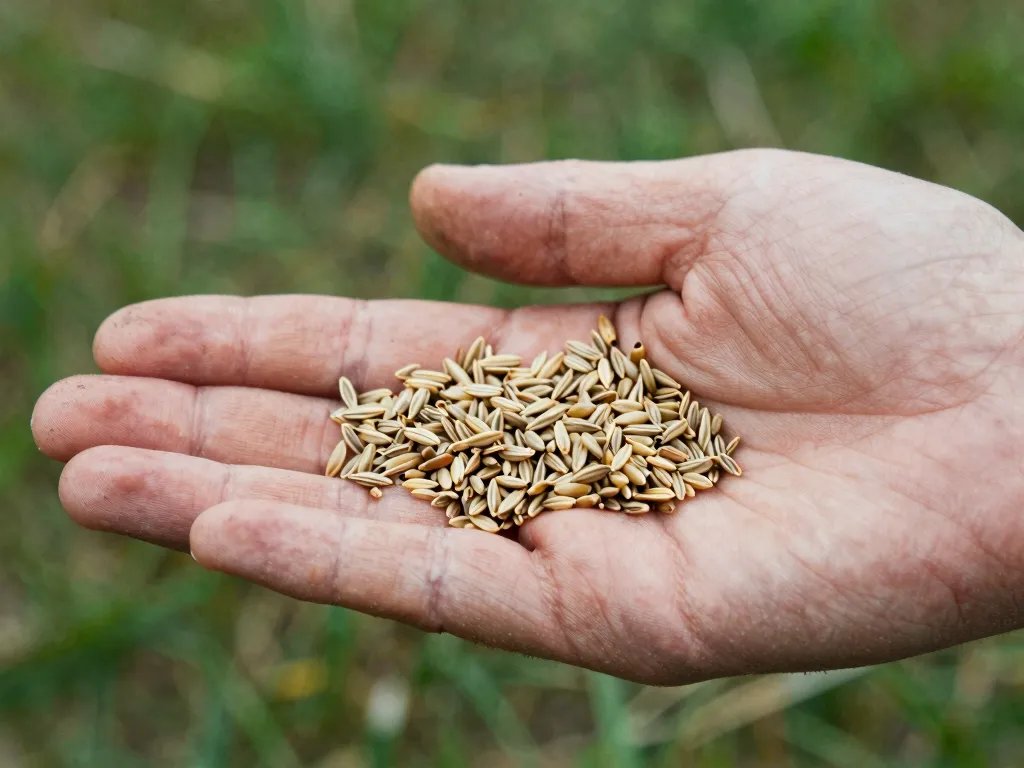
A newly seeded lawn using turf‑type tall fescue requires 6 to 8 pounds of seed per 1,000 square feet.
What the rate depends on
That 6–8 lb/1,000 ft² figure assumes you’re planting turf‑type tall fescue alone, under typical lawn conditions—well-prepared soil, full sun or partial shade, and normal watering. The University of Maryland Extension recommends this for initial lawn establishment (extension.umd.edu). The rate stems from a broader set of extension data, including UMass Amherst, which lists 7–9 lb/1,000 ft² as its seeding rate for tall fescue (umass.edu).
Regional and condition variation
In Pennsylvania, the turf-specific extension guidance aligns: 6–8 lb/1,000 ft² for turf-type tall fescue, even in shaded or heavy-use areas (extension.psu.edu). Georgia’s extension, focused more on forage, recommends a rate of 15–20 lb per acre (broadcast)—which converts roughly to 0.34–0.46 lb/1,000 ft²—but that’s aimed at pasture rather than lawns (georgiaforages.caes.uga.edu). That’s far below lawn‑recommended rates—because pastures rely on lower density, wider spacing, and different establishment criteria.
Oregon State’s turf guidelines say 5 lb/1,000 ft² is workable for turf-type tall fescue, but you may want to add 2 lb more—i.e., up to 7 lb total—especially if conditions are less than ideal (horticulture.oregonstate.edu). Iowa’s extension similarly suggests seeding at 7–9 lb/1,000 ft² (yardandgarden.extension.iastate.edu).
Common mistakes that cause problems
If you use too little seed, expect thin lawns, patchy coverage, and extended time for full fill-in—that invites weeds. On the flip side, overseeding too heavily won’t improve establishment much but can create maintenance issues like matting or fungal problems.
Another widespread mistake: not adjusting rates based on seed quality. Those extension guidelines assume use of pure live seed (PLS)—seed that’s viable and weed-free. If your seed mix has lower germination or purity, you’ll need more seed to reach the same effective coverage. Always check the PLS percentage.
Timing and seed-to-soil contact matter. Even the right rate won’t work if the seed’s planted too deep or the soil’s loose. Extension advice is to aim for no more than ½‑inch depth, ideally about ¼‑inch, with some seed still visible on the surface (extension.psu.edu).
Cost and timing considerations
Using 6–8 lb of seed per 1,000 square feet helps you budget accurately. Seed cost varies, but assuming around $4–$6 per pound for good quality turf-type tall fescue, a 5,000‑square‑foot lawn would cost $120–$240 just for seed.
Timing-wise, late summer through early fall is prime for cool‑season grasses like tall fescue—soil is still warm, there’s decent rainfall, and weeds are fading. UMass and other extensions consistently recommend this window for best germination and root development before winter (umass.edu).
What to ask your supplier or pro
• Is your seed turf‑type tall fescue? You want that varietal for lawn quality, not pasture or forage types.
• What’s the Pure Live Seed (PLS) percentage? It tells you how much viable seed you’re actually getting.
• What’s the recommended seeding rate per 1,000 square feet for lawns? Make sure they align with extension guidelines.
• Can you adjust the mix if I want shade tolerance or a clover blend? For example, North Carolina’s extension suggests adding 0.2–0.3 lb of clover per 1,000 ft² if you want a clover component alongside 6 lb of fescue (ces.ncsu.edu).
Wrapping up
You want 6 to 8 lb of turf‑type tall fescue seed per 1,000 square feet for your new lawn. That gives you the density needed for a healthy, durable stand—without wasting seed or setting yourself up for weak coverage. Check the seed’s PLS, plant into a firm, shallow seedbed (¼‑ to ½‑inch), and plan for fall planting if possible.
For exact quantities and help with your yard’s dimensions, head over to the Lawn Seed Planner.
Sources
- Grass Seed | University of Maryland Extension
- Seeding Rate Considerations : Turf : Center for Agriculture, Food, and the Environment (CAFE) at UMass Amherst
- Turfgrass Seed and Seed Mixtures
- Establishment Guidelines - Management | Forages
- Practical Lawn Establishment and Renovation, EC 1550 (Oregon State University Extension Service)
- Turf-type Tall Fescue | Yard and Garden
- Hay and Pasture Renovation Decisions